

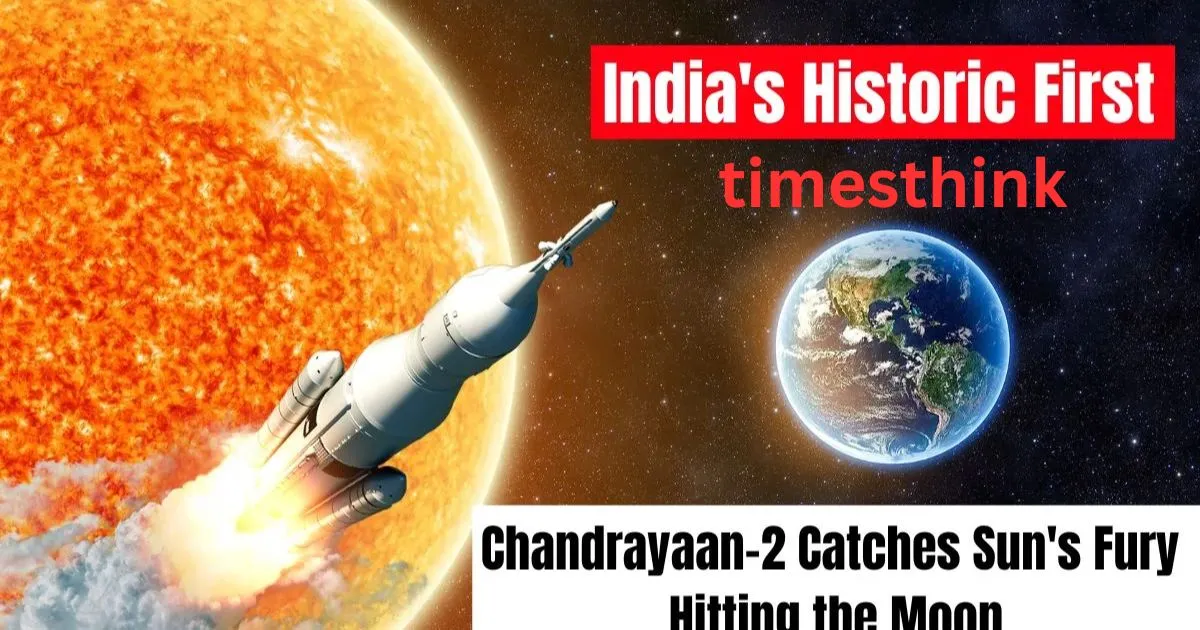
- New history has been made in the world of science.
- Mission Background: The Journey from Launch to Orbit
- CHACE-2: Guardian of the Moon's Atmosphere
- Rare solar event of May 10, 2024
- From science to reality: theory proven
- The Moon's Fragile Atmosphere | An Unsafe World
- Impact on future missions
- India's scientific superiority
- Scientific publication and global validation
- Conclusion: New Understanding, New Era
New history has been made in the world of science.
Chandrayaan-2 sees solar storm hitting the moon : The Indian Space Research Organization (ISRO) has achieved a feat that has amazed scientists around the world.
For the first time , instruments on the Chandrayaan-2 mission have directly observed the effects of a massive solar explosion a coronal mass ejection (CME) on the delicate atmosphere of the Moon.
The discovery was not part of the original mission’s objective, but it has given humanity a new perspective on the lunar exosphere , and helped us understand how space weather changes the Moon’s surface.
ALSO READ : Faith, passion, excitement and a flying kiss | Jemima Rodriguez’s incredible night
Mission Background: The Journey from Launch to Orbit
The mission was launched from Sriharikota on 22 July 2019 aboard a GSLV-M3M1 rocket . Chandrayaan-2 was equipped with eight scientific instruments , which were intended to study the lunar surface, its structure, and the space environment around it.
Although the Vikram lander lost contact with the Earth during its landing on 7 September 2019, the orbiter is still sending valuable scientific data while orbiting in a 100×100 km orbit.
CHACE-2: Guardian of the Moon’s Atmosphere
One of the key instruments on Chandrayaan-2 is the Chandrayaan-2 Atmosphere Compositional Explorer-2 (CHACE-2) .
Its primary objective is to study the amount, distribution, and temporal changes in the amount of neutral atoms and molecules around the Moon .
The instrument uses highly sensitive sensors to detect subtle differences in the density of the particles , in order to understand how solar radiation, micrometeorites, or gases emitted from the Moon’s surface affect the atmosphere.
Rare solar event of May 10, 2024
On May 10, 2024, an unusual event occurred several CME explosions originating from the Sun hit the Moon one after another .
During this time, CHACE-2 recorded a significant increase in atmospheric pressure on the dayside of the Moon .
Simply put, the extremely thin layer of gas surrounding the Moon suddenly thickened for a while meaning that particles from the Sun and high-speed winds ejected more atoms from the Moon’s surface.
ALSO READ :AliExpress Affiliate Program: Proven Easy Steps to Make Money
From science to reality: theory proven
For many years, scientists have theorized that when the sun’s activity increases, the amount of particles around the moon also increases, but this has never been directly confirmed.
CHACE-2 's observations showed that the amount of inactive particles increased tenfold during this time.
Thus, for the first time, it was practically proven that solar storms have a profound effect on the moon's atmosphere.
The Moon’s Fragile Atmosphere | An Unsafe World
Unlike Earth, the Moon has no magnetic field , so it is completely exposed to solar winds and space particles. Its atmosphere is so weak that particles do not even collide with each other.
This is why even small changes in the Sun can produce temporary but measurable effects in the Moon's atmosphere, such as an increase in the amount of sodium or potassium .
Impact on future missions
This discovery is very important for future space missions.
Design and safety: Future landers and rovers must be designed to be protected from solar particles and charging.
Human Settlement: If humans are to inhabit the Moon in the future, they will need radiation protection, air purification, and filtration systems .
Weather forecasting: ISRO is now developing models that can predict the moon’s “weather”.
India’s scientific superiority
The consistent and accurate data obtained by Chandrayaan-2 is a prime example of India’s scientific excellence.
This discovery not only strengthens India’s space credentials but also provides new insights for the global scientific community.
As the world prepares for future lunar colonization and deep space missions , this research has come as a guide.
Scientific publication and global validation
The research, titled “Impact of a Coronal Mass Ejection on the Lunar Exosphere as Observed by CHACE-2 on the Chandrayaan-2 Orbiter ,” was published in Geophysical Research Letters on August 16, 2024.
The publication proves that sensitive instruments like CHACE-2 can not only notice subtle changes but also accurately record powerful space events .
Conclusion: New Understanding, New Era
Chandrayaan-2’s CHACE-2 instrument has revealed that solar storms have immediate and severe effects
on the lunar atmosphere.
This discovery provides a basis for future missions, improves designs, and helps understand the lunar environmental conditions .
This is not only a scientific achievement but also a shining testament to India’s space commitment and research capability . this first direct observation of the Sun’s effects on the moon’s silent surface opens a new chapter in human knowledge.







Leave a Comment